Story
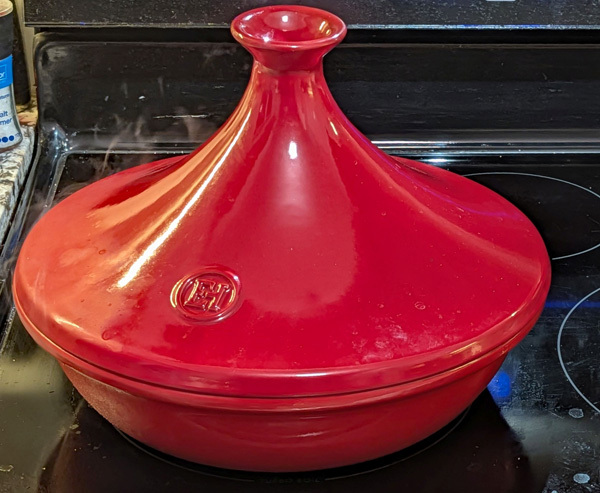
Just a few days after New Year 2026, I received an unexpected present delivered to my door. First, I did not know who the Secret Santa was (I know now). The package contained Tajine, an earthenware pot originally from Morocco or more generally North-Western Africa. My version was made in France, and is glazed, in which it differs from the original un-glazed pots. I had no idea what to do with it, but the internet does.
The first comment from my son was: someone must know you very well; they know you like to cook, and they managed to send you a kitchen gadget that you don’t already own! Touché!
Anyway, I felt it was a challenge for me. I explored available tajine recipes (the dish is named the same as the pot). The pot is meant for slow cooking, and there are claims that its conical top is designed to trap steam and flavours, and the condensation would return them to the cooked dish.
I decided to use it first time to prepare some lamb, as I felt it would match the Moroccan and North African origins of tajine. Also, I was quite successful in the past slow cooking lamb. I decided to somewhat limit and modify the gamut of spices used in traditional tajine to only those I had experience with and like. Hence, I eliminated cinnamon, which I only like in sweet baking. I added sage, which I think goes well with lamb. In my first trial I decided not to add tomato paste, which is suggested by most recipes.
Recipe

Ingredients
| 1.5 kg | lamb shoulder blade chops Note correction of the amount previously specified as 1.5 lb |
| 2 | large onions, cut into half-circles |
| 1 | large leek, cleaned and cut – the white portion into 1/4 inch slices, the green leaves into pieces about 4 inches long |
| 2 | celery sticks, cut across into 1/4 inch slices |
| 4-5 | cloves of garlic, finely chopped (not squeezed) |
| as needed | vegetable oil for frying |
| Spices: | |
| 1 tsp each or to taste | ginger, ground mustard powder sweet Hungarian paprika turmeric ground black pepper ground sage salt |
| 1/4 tsp each or to taste | ground cloves ground nutmeg sumac (spice – do not confuse with poison sumac from North America) hot pepper flakes or hot Hungarian paprika |
| 1-2 cups | chicken broth, enough to cover the meat in the tajine to two thirds level. |
| 2 | medium carrots, cut half length then into 1/8ths length wise. |
Directions
- Cut the meat off the bone and remove most of the hard fatty pieces. The strong characteristic aroma of lamb comes from its fat. The marbling fat that is not hard is ok.
- Cut any larger pieces of the meat into pieces about 2 inches in size.
- Add all the spices and mix them with the meat in a bowl. Let the mixture sit while preparing vegetable bed.
- In a large frying pan, saute the onions in oil until translucent and light-golden.
- Add chopped garlic and mix with onions. continue sauteing only briefly.
- Add leeks and continue sauteing for about 1-2 minutes, then add sliced celery and continue sauteing until all ingredients become soft.
- Transfer the sauteed vegetables to the tajine bowl and spread evenly over the bottom..
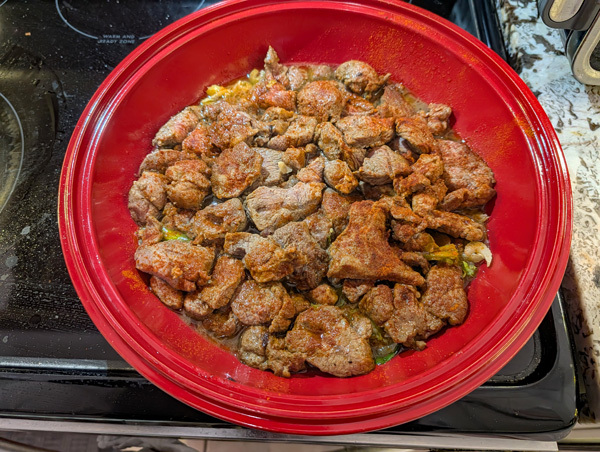
- In the same pan, brown the meat on all sides on relatively high heat flipping frequently. You may need to do this in portions so that the meat browns. If you overload the pan the meat will stew instead of browning.
- Lay the meat in the tajine on top of the vegetable bed.
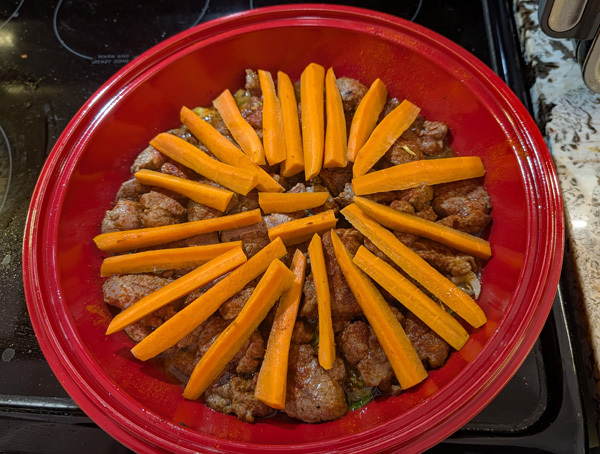
- Lay the cut carrots on top of the meat.
- Pour in chicken broth to cover meat to about two thirds level.
- Put the tajine cover on top, and place the tajine pot on the burner of matching size. The tajine pot can be used on any stove, but for gas stove you may need a heat distributing plate under it, and for induction cook-top you need an induction-compatible (magnetic) heating plate/diffuser. I have a ceramic top stove, so I can put the tajine directly on the heating element.
- Set the heat to low and as soon as it heats up, lower the setting even more. My stove has regulation from 1(low) to 10(high). I found optimum setting at 2.4. It keeps the content gently simmering. If you use a setting that is too high the dish may burn at the bottom.
- Cook for 1.5 – 2 hours. You can check the progress by raising the cover, but do not uncover it for longer than necessary.
- The dish is ready when the sauce has reduced down to thick consistency, and the meat is very tender, almost melting in your mouth.
- Originally it is served over couscous, but I prefer mashed or baked potatoes.
The dish was definitely a success. In my future experiments with tajine, I will play with various spices and their amounts, and later using different meats. I will update this post with any changes/improvements.