 Herring in oil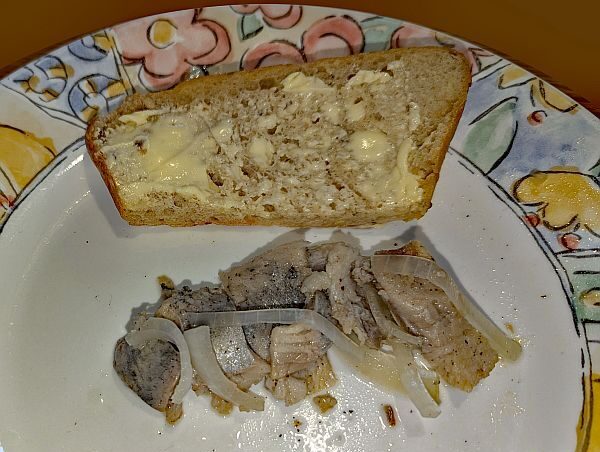
Herring is almost always served around Christmas and Easter, especially on Christmas Eve, which in Polish tradition is a day of fasting i.e., no meat is served. It is also served on other days of fast: Good Friday, Ash Wednesday, and Fridays during Lent. But it is not just a holiday dish – you can find it on Polish tables on any day of the year.
Recipe
This post contains two recipes for herring: marinated in vinegar and just herring in oil. As you will see, the latter is hardly a recipe, so it wouldn’t deserve a separate post.
In the past (like 50 years ago) herring was stored salted in barrels. It needed to be soaked for long time in water to remove excess salt. Nowadays, with advances in refrigeration, freezing, and vacuum packing, you can buy herring that does not require this extra step. Instead you can get herring that is similar to Dutch style fresh herring. The best herring is called Matjas or Matjes. This is a young herring that hasn’t spawned yet. It is cleaned, briefly cured in light brine, then filleted and packed. There are also packages marked A’La Matjes that often are older fish, but still are quite good.
When buying herring, pay attention to the ingredients. Avoid those that have citric acid high on the list. It will cause the fish to be kind of cooked and stiff and leathery. Because you often buy it frozen in a package, it is hard to tell by touch, if meat is stiff or not. A little of sodium citrate is ok but citric acid is not.
Another ingredient to check is amount of salt, listed as sodium and reported per serving size. This can vary from about 600 to 1600 mg per 50 g serving. Every producer selects serving size: I have seen 50, 55 and 100 g on the labels, so you have to do your math. I try to stick to values around 800 mg 50 g serving. Sure you can soak the fish in water for an hour or so, but doesn’t it defy the purpose?

Ingredients
| 1 kg | Herring package, it contains about 800 g of fish. |
| 1 | Large onion |
| 500 mL | 3% Vinegar (for marinade): mix 300 mL of 5% vinegar and 200 mL of water. |
| 5% vinegar in a spray bottle | |
| 10 | Allspice, dried berries |
| 30 | peppercorns |
| to taste | Freshly ground pepper |
| 1 | Bay leaf, large or 2 small |
| 3/4 tsp | Salt |
| 1.5 tsp | Sugar |
Directions
- In a small pot, bring to boil 3% vinegar with addition of peppercorns, allspice, bay leaf, sugar, and salt. Continue boiling at lower heat for 6 minutes. Cover and let it cool to room temperature.
- Peel and cut in half the onion. Chop finely one half of it, and cut the other half into quarter rings. Pout boiling water over the quarter-ring pieces and allow to cool. This prevents the onion to discolour when placed into the marinade.
Fish preparation: - Open the package of herring, drain all oil it came with and pat dry the fillets with paper towels.
- Spread the fillets on a cutting board and spray lightly both sides of each fillet with 5% vinegar.
- Pepper lightly both sides of the fillets with freshly ground pepper.
- Cut the fillets into bite-size pieces, about 1 inch in size.
Marinaded Herring: - Strain the cooled onion quarter rings on a sieve.
- Layer half of the herring pieces in the jar, separating the layers with the blanched onion quarter rings.
- Cover with the prepared marinade and close the lid. Make sure there is no air trapped between the layers.
- Keep in a fridge for a day or so before serving. It needs time to fully marinade. It can be kept for at least a week or two.
Herring in oil: - Layer the remaining pieces of herring in another jar separating the layers with the freshly chopped onion.
- Pour good quality, low flavour oil1 to cover all the pieces of herring and onion. Use a spoon handle to dislodge any air trapped between the pieces.
- Herring in oil can be served immediately, but some people like the flavours to equalize between the fish and onion for a day or so..
- When serving, you can top both herring kinds with freshly chopped green onions.
Footnotes:
- I prefer Crisco soybean oil for this, as it has fresher taste than some other oils, and almost no flavour. It has some citric acid added that may protect it from going rancid. Oil ages primarily by oxidation and hydrolysis (reaction with moisture). While citric acid is essentially insoluble in oil, even trace amounts may have an effect on the stability of the oil. ↩︎