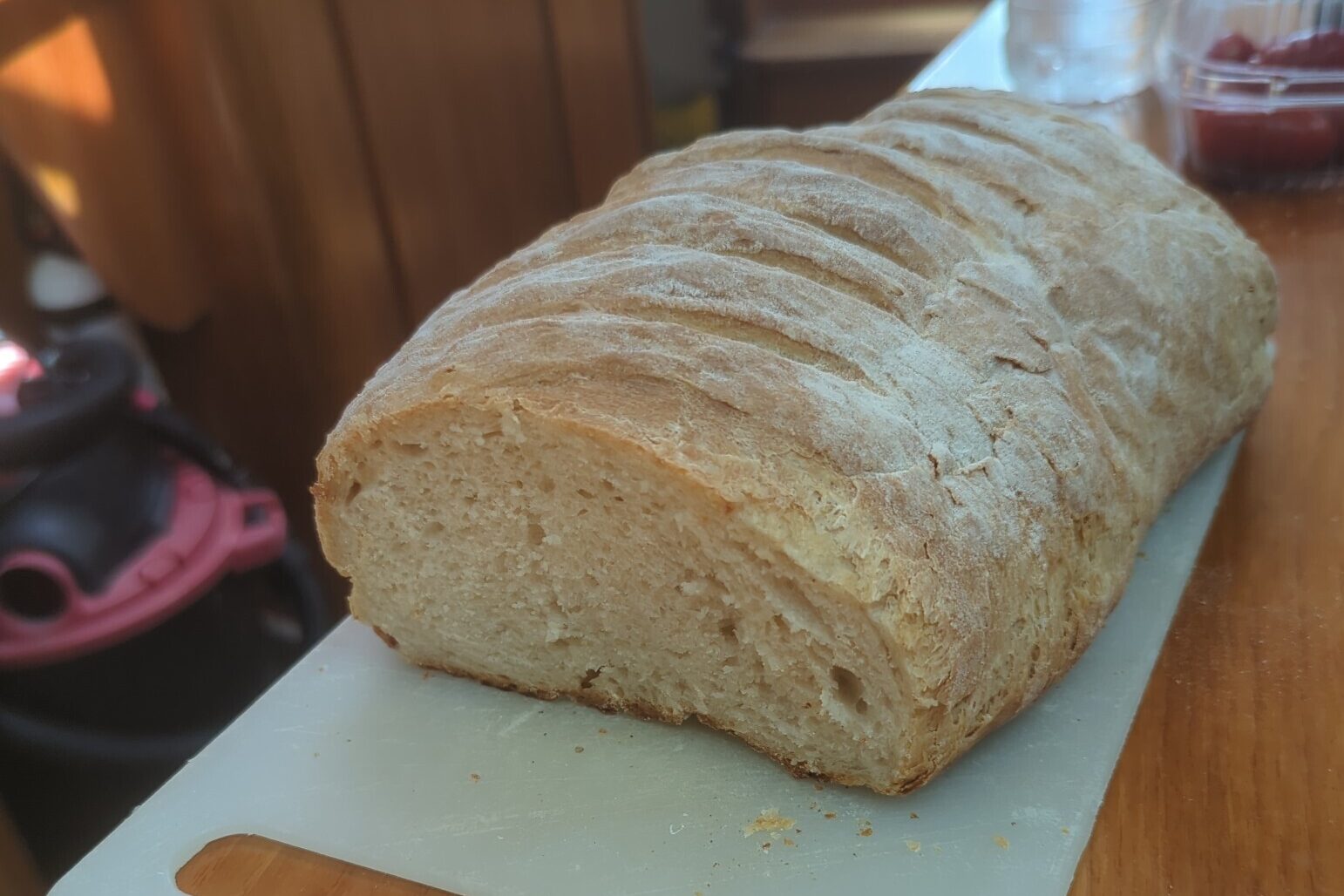
Simple Bread

Ingredients
| 500 g | Flour (any flour will do, but I prefer unbleached or best for bread). Some extra flour needed for kneading. |
| 8 g (1 envelope) | Dry Rapid Rise Yeast (Note 2) |
| 2 tsp | Salt |
| ~400 mL | Warm water (~30-35°C) (Note 3) |
| 2 tbsp | Extra Virgin Olive Oil (optional) |
Recipe:
- Mix dry ingredients (flour, yeast, salt) in a bowl.
- Add water in portions while hand mixing and kneading (You may need a bit less or more water depending on the flour).
- Once the ingredients are well mixed, add olive oil and knead to incorporate.
- Transfer the dough onto a flat surface dusted with flour.
- Knead by pressing down and rolling until the dough is smooth and no longer sticks to your hands (about 5 minutes).
- Form a loaf and put it on a baking sheet. Let it rise for about 1-2 hours depending on the temperature. For faster rising, I put the loaf into a slightly warmed oven, especially when it is cold on the boat.
- Once it rises to about double the size, take it out of the warm oven (if you used it for rising), re-form the loaf, and let it rise again, while waiting for the oven to reach the baking temperature (400°C).
- Bake for about 45 minutes. You can check if it is ready by using a skewer to poke the bread – it should come out without any dough sticking to it.
Notes
- While rising, the bread will likely spread and flatten somewhat, so you may try to push the sides and bottom under and inwards after first rise and immediately before baking. You may also opt to bake it in a form, rather than on flat baking sheet. 9x5x5” form should be suitable size.
- Other dry yeast will work too but may need more time to rise. On the boat, it is convenient to use single portions sold in sealed envelopes, by Fleischmann and others. Rapid Rise Instant yeast can be mixed with dry ingredients, while traditional dry active yeast may need to be activated by sprinkling it over a cup of warm water with addition of one tsp of sugar, and waiting for them to become foamy. You may also need a little more yeast for the same amount of flour.
- With experience you will learn how much water to use. If the dough is too loose, you can add some extra flour while kneading it on the flat surface. If too dense, you probably can add some extra water, but while still mixing it in the bowl.
Update Jan 2026: - When baking at home I double the recipe and substitute about 50 g of wheat flour with 50 g of rye flour. It is very little but does make the bread more flavourful. I also started to add 1/4-1/3 of a package o Dr. Oetker Dried Sourdough Starter. It does not replace the yeast, but again changes the flavour. The doubled recipe is suitable for baking bread in a Dutch Oven. Original amounts would yield very flat bread – I tried and it spread to cover the full bottom of my Dutch Oven. It still tasted good, but it was much harder to make sandwiches with it.
- It is important to let the bread rise two times, both to double the size. To shorten the time required for this keep it in a warm place. I try to keep the temperature at about 30-32°C (86-90°F). I put it in a lightly warmed oven, or in a covered bowl over my InstantPot filled with warm water and set to Yogourt-Low program.↩︎